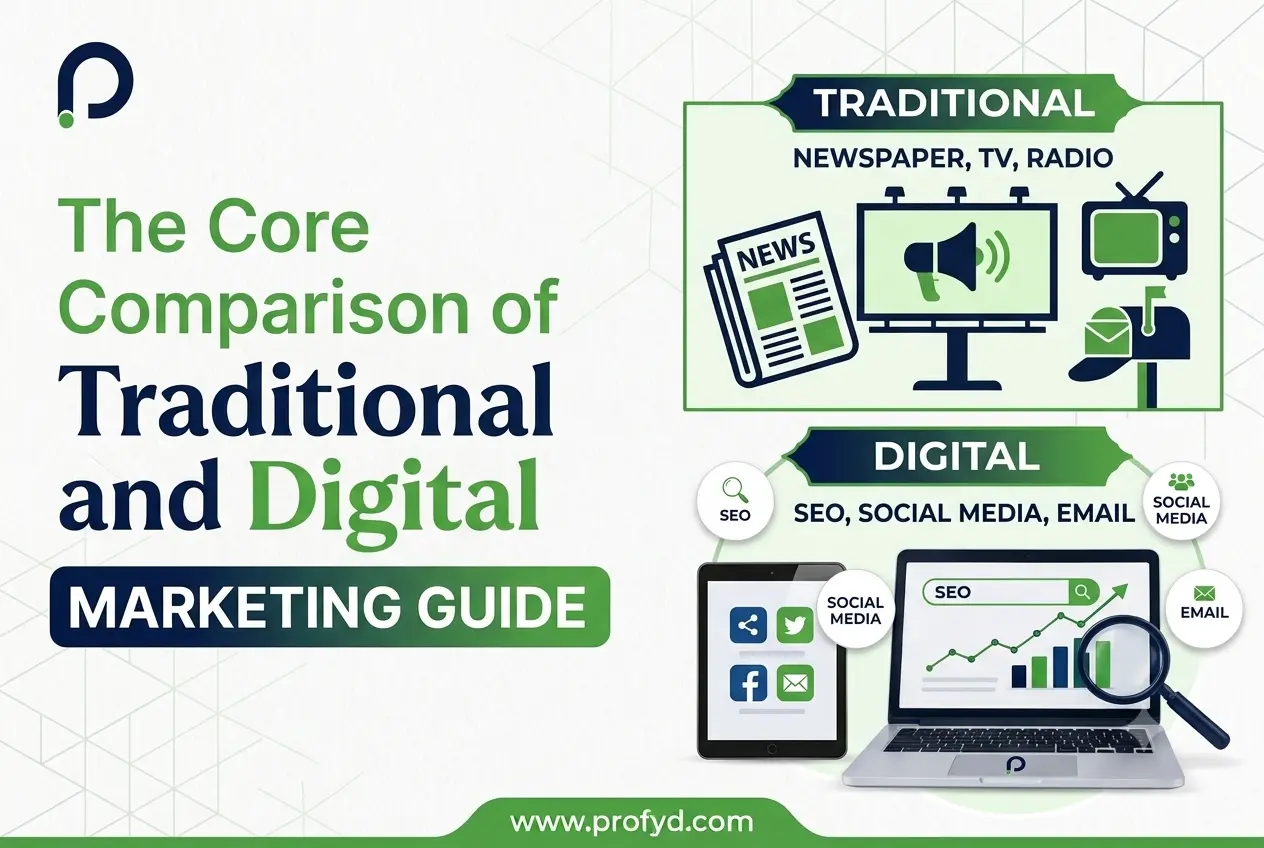
Comparing Traditional and Digital Marketing Strategies
Marketing has always been kinda about one core purpose: putting the right message in front of the right people. What changed a lot in the last two decades is the way that message is delivered. At Profyd, we support businesses across Lahore, Pakistan, recruiting for both traditional and digital marketing jobs, and one question keeps popping up again and again from students, career changers, and honestly even business owners: What is the real difference between these two approaches, and does traditional marketing still matter at all in a digital-first world?
The honest answer is kind of more nuanced than most people think, honestly. Traditional marketing has not disappeared, it sort of evolved and changed. If you really get both approaches at once, you end up with a stronger foundation, whether you’re trying to build a career in marketing or you’re growing a business right now.
Defining Traditional Marketing
Traditional marketing is the offline route that was in charge of advertising for most of the twentieth century, such as television spots, radio promotions, print notices in newspapers and magazines, billboards, direct mail, and face-to-face events. These tactics lean on broad, often one-directional communication, meaning the company sort of creates a message and then pushes it out to a huge crowd, but with not much capacity to measure who exactly witnessed it or what or how they responded back.
This doesn’t mean traditional marketing is completely useless, nope. Actually, in a lot of situations it still works pretty well; certain industries and audiences do respond strongly to these kinds of approaches, especially older demographics or even local businesses aiming at very specific geographic communities, you know.
Defining Digital Marketing
Digital marketing, by contrast, covers pretty much everything that’s going on online, like search engine optimization, social media marketing, email campaigns, pay-per-click advertising, content marketing, and influencer partnerships. And yeah, unlike traditional stuff, it lets brands aim at the right people more precisely, watch results in real time, and keep a two-way conversation happening between the business and its audience.
That basic difference, the ability to measure plus tweak campaigns in real time, is usually mentioned as digital marketing’s main advantage compared to older, more traditional methods.
Cost Differences Between the Two Approaches
One of the more important differences really sits in the cost structure. Traditional marketing, mostly television and print advertising, often asks for a big upfront outlay with less room to adjust once a campaign is running. Like, a weak-performing television ad still costs the same, no matter the outcome or whatever results come back.
Digital marketing usually gives more flexible and somewhat adjustable pricing models. Businesses can begin with smaller budgets, run quick variations, or “test ideas,” then increase spending only on the campaigns that show real impact. This is why digital marketing becomes so appealing for smaller businesses and new startups in Lahore, especially those that don’t have enough funds for large-scale traditional marketing, you know, the kind.
Measuring Results: A Major Point of Difference
Maybe the most clear distinction between these two approaches sort of, comes down to measurement. Traditional marketing has, historically, struggled with exact ROI tracking. A billboard might trigger awareness, but turning that awareness into direct sales is still hard without quite a bit of extra research.
Digital marketing kind of solves this problem by using analytics, and it is a bit more measurable than people expect. Businesses can track how many people actually saw an ad then, clicked it, and finally finished the purchase, so you end up with clear takeaways that traditional marketing just can’t do. This level of measurability is a big reason digital marketing budgets have grown so much lately, honestly.
Audience Targeting Capabilities
Traditional marketing is usually aimed at wide demographics, you know, like a TV commercial that airs to everyone watching that channel at that exact time, regardless of what someone actually cares about or if they even have interest in the product being advertised. Digital marketing, however, makes it possible to aim a lot more precisely; businesses can connect with specific age brackets, individual interests, nearby areas and even browsing patterns, so the message lands on people who are more likely to care, not just random viewers.
And that precision, sort of, cuts down quite a bit of the wasted ad money, which is a big reason digital marketing is now the go-to method for businesses with limited budgets, where every rupee really has to do its job efficiently.
Traditional Marketing Still Has Real Advantages
Traditional marketing is usually aimed at pretty broad demographics you know, like a television commercial that airs for everyone watching that channel at that exact time, even if someone doesn’t really care much or if they have zero interest in the product being advertised. Digital marketing on the other hand lets businesses target things way more precisely, like they can connect with certain age brackets, individual interests, particular locations, and even browsing patterns, so the message actually lands on people who are more likely to care, not just random viewers.
And that kind precision also cuts down a lot of the wasted advertising money, which is a major reason digital marketing is now the go-to approach for businesses with limited budgets, where every rupee has to do its job efficiently.
The Rise of Hybrid Marketing Strategies
Rather than picking one method only, a lot of modern businesses end up mixing traditional and digital marketing, kind of on purpose. For instance, a company could run television advertising for wide brand awareness while at the same time launching very targeted online campaigns that push specific next steps like landing on a website or buying something. This hybrid approach uses the best parts of each lane instead of making you choose between them, like it has to be either one or the other.
Career Implications for Marketing Professionals
For anybody trying to build a marketing career, it helps to understand both old-school and newer digital ways because the combined knowledge gives you, like, a real leg up. Today digital marketing skills are often more in demand, especially for roles such as SEO specialists jobs, social media managers, and paid advertising experts. But people who also grasp traditional marketing fundamentals, brand positioning, steady message consistency, and audience psychology usually end up with a more rounded view when they do their digital work.
Also, a lot of the successful digital marketers you see, they sort of borrow from traditional marketing psychology too. They understand audience emotions, build brand trust, and then craft messaging that actually lands, even across online channels. So yeah, these areas aren’t fully separate. They end up being complementary, more like the same toolkit with different compartments.
Which Approach Should Businesses in Lahore Choose?
For a lot of businesses in Lahore, Pakistan these days, digital marketing gives a more reachable, measurable, and scalable starting point, especially for smaller outfits or early startups that have limited marketing budgets. But this doesn’t mean traditional marketing should be thrown out completely. In fact, local shops that aim at very specific community demographics, or older companies with good brand recall already built through TV, print, and other offline channels, often do better when they keep at least some traditional presence while they also run digital campaigns.
The best combination basically comes down to who the target audience is, what the budget looks like, and the actual business goals, not a one-size-fits-all kind of response.
How Profyd Supports Marketing Careers Across Both Fields
At Profyd, we list marketing roles throughout Lahore Pakistan, basically covering the whole spectrum. You’ll find digital marketing specialties such as SEO and social media management, but also positions that use more traditional marketing bits, like event coordination and brand management. If you’re trying to grow your career in digital channels or you’re more into roles that fuse both old school and online strategies, our listings have onsite options too. Depending on what the employer needs, there are flexible day shifts and night shift alternatives, so it fits different lifestyles.
Conclusion
Traditional and digital marketing aren’t exactly battling it out as competing forces, more like complementary tools that do different things depending on who you’re trying to reach and what you’re aiming for. When you really understand both approaches, you end up more adaptable as a marketing professional, and you can craft strategies that genuinely click, not just look good on paper.
If you’re in Lahore, Pakistan, and you’re shaping a career in marketing, whether you’re going traditional, digital, or even mixing both, Profyd helps connect capable professionals with active job openings across the whole industry. Reach out to the Profyd team today and check what roles are currently available.
Frequently Asked Questions
Is traditional marketing becoming obsolete?
No, while its dominance has decreased, traditional marketing still holds value for specific audiences and industries, particularly when combined with digital strategies.
Which pays better, traditional or digital marketing roles?
Digital marketing roles, particularly specialized positions like SEO or paid advertising, often command higher salaries currently due to strong market demand.
Can someone transition from traditional to digital marketing?
Yes, many marketing principles overlap, and professionals with traditional marketing backgrounds often successfully transition into digital roles with proper training.
Do businesses in Lahore still use traditional marketing?
Yes, particularly local businesses and those targeting specific demographics, though most now combine it with digital efforts for broader reach.