Why Math Teaching Jobs Come with Unique Challenges?
Teaching mathematics is one of the more demanding and, honestly, also more rewarding roles in education. Unlike many other subjects that lean on memorization or quick interpretation, maths asks students to grow logical understanding step by step. And when that base starts to crack, everything built after it becomes wobbly, like… unstable. For anyone chasing a career in math teaching, or already in that position, it matters a lot to grasp the recurring hurdles of this profession, plus ways to handle them, so you can become genuinely effective in the classroom. Profyd recognizes how crucial skilled maths educators are, and it actively backs the people working in this area. Due to high understanding of teaching international students and national students, Profyd is providing math teaching jobs in Pakistan and other jobs in Lahore, where you can teach while learning new teaching techniques that meet international standards.
The Reality of Math Anxiety in Students
Math anxiety is honestly one of the most widespread things math teachers deal with. A lot of students walk into a maths class already convinced they are not good at the subject, like, right away. That belief is usually shaped by some early bad experiences, and it then turns into this mental wall, which makes learning feel genuinely harder. Not because the student lacks the ability, but because fear shows up and messes with attention and slows down how information gets processed.
So, the fix really begins with the classroom environment and how it is built up. When teachers regularly frame mistakes as just part of learning, instead of something that counts as a failure, students gradually change their relationship with difficulty. Low-pressure practice, working things out together, and making a point of noticing small progress can chip away at math anxiety over time. It’s not instant, but with steady consistency, it does work.
Bridging the Gap Between Concrete and Abstract Thinking
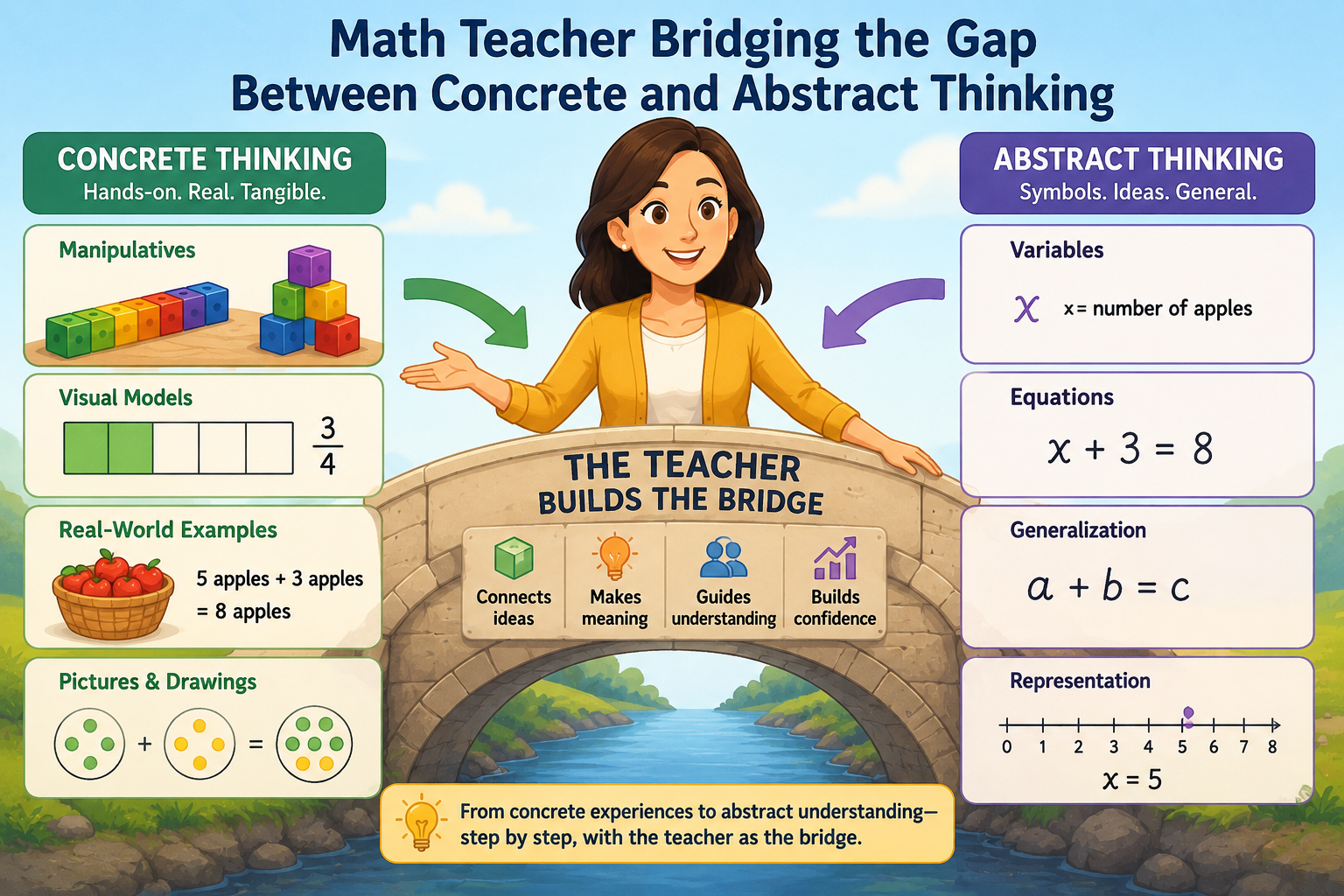
Mathematics kind of moves from concrete things into abstract symbols, and students don’t always make that shift in a smooth way. Like, a child might get adding apples, but then when the same idea shows up with variables, equations, and all that, it can suddenly feel confusing. That conceptual jump is one of the most usual spots where math education tends to snag people.
Good maths teachers then use manipulatives, visual models, and real-world examples to build a bridge between what you can hold and what you write down. Instead of rushing too fast into formal notation, they spend a little more time letting students see and touch the idea – with blocks, graphs, drawings, or everyday situations. That extra time helps make those abstract concepts more reachable, and honestly, easier to remember.
Differentiating Instruction for a Mixed-Ability Classroom
In any given math class you’ll find students going all over the place, from the ones who are really struggling just to keep up to the ones who look bored because the pace is kind of too slow. Teaching to the middle, which a lot of educators kind of default to, ends up leaving both ends behind. It’s a bit of a tricky, persistent structural challenge in math teaching jobs.
Differentiation strategies can include flexible grouping, tiered assignments, and giving extension tasks to the more advanced kids while also providing scaffolded support for students who need extra help. And yeah, technology can play a role too; adaptive learning platforms let students proceed at their own rate while the teacher keeps an eye on progress across the whole class, stepping in when it’s actually needed.
Making Math Relevant to Students’ Lives
One of the most common complaints students have is that they don’t understand why they even need to learn something. When maths is taught in isolation, like a set of steps to memorize with no context, motivation drops pretty fast. And this seems even more obvious in higher-level maths, because the material can feel like it’s drifting away from everyday life, bit by bit.
If you connect math to real situations, the whole dynamic changes. Personal finance, architecture, sports statistics, technology, and even cooking… all of those involve real mathematical thinking, not just abstract stuff. When students notice that the skills they are building actually show up in practice, engagement tends to rise, and they remember more too. Of course this takes creativity and planning from the teacher, but the payoff for student motivation is honestly worth the effort.
Managing the Pressure of Curriculum and Standardized Testing
Math teachers often say they feel like they’re stuck in the middle, you know, between teaching with real depth and the pressure to finish the whole curriculum before standardized tests. And when those pacing guides are too rigid, it turns into this whole thing where teachers end up moving fast through ideas that students haven’t really understood yet. Then later on the missing pieces stack up, and the next topics start to feel even more difficult.
A more sustainable route is to put the foundational concepts first, instead of chasing breadth. Like, a student who genuinely grasps proportional reasoning can manage a bunch of connected subjects more smoothly, compared to a student who’s just had brief exposure to a pile of procedures. Working together with school leadership to shape a more flexible pacing system—while still meeting the curriculum demands—is a continuing conversation, and honestly, it’s one worth having.
Supporting Students Who Have Fallen Behind

In any math classroom, there will be students carrying gaps from previous years, kind of quietly. A student in eighth grade who never really fully grasped fractions will have trouble with algebra, not because algebra is out of reach for them, but because the base knowledge is simply missing. Figuring out and covering those gaps, without embarrassing anyone or turning it into a “look at me” moment, takes quite a bit of skill and sensitivity.
Diagnostic assessments at the start of a unit can help teachers see where each student actually is before instruction begins. Things like small group pull-outs, brief one-on-one check-ins, and well-structured peer tutoring can work really well as targeted help without derailing the broader class rhythm.
Technology in the Math Classroom: Opportunity and Distraction
Technology gives maths teachers powerful tools, like graphing calculators, dynamic geometry software and educational apps that can show abstract ideas in a way that static diagrams just can’t. That said , technology can also create distractions, cause technical issues, and bring the risk that students treat the tools like shortcuts instead of learning aids, which is honestly kind of common.
A balanced way is to use technology on purpose—to explore, uncover, and visualise—rather than swapping it in as a stand-in for real understanding. When teachers set clear norms about when devices are allowed and pair that with tasks that actually demand thinking (not only clicking), then the benefits of technology show up, while the negatives get kept under control.
Professional Development and Staying Current
Mathematics education keeps evolving, and you kind of notice it, with research on how students learn maths, new pedagogical approaches, and updated curriculum frameworks. So teachers who stop learning quickly kind of fall behind when it comes to best practices. But still, professional development opportunities are often limited, feel generic, and somehow end up disconnected from what teachers actually deal with in their own classrooms, day to day.
What helps is seeking out subject-specific professional learning communities, reading the latest research on math pedagogy, and connecting with other math educators — even online. That kind of ongoing exchange helps fill the gap, little by little. In the end, the best math teachers treat their own professional growth like it is student learning too: an ongoing process, not some finish line.
Conclusion
Teaching math is not easy, but it feels profoundly impactful, honestly. Each little challenge you meet in the classroom has some workable answer; the whole trick is to step into the lesson with curiosity, flexibility, and that real commitment to helping students improve. The strongest maths educators are the ones who treat their own growth with the same seriousness as they treat their students’ learning.
If you are dealing with the complexities that come with a math teaching job and you’re also looking for fresh chances or professional support, Profyd is ready to help. The Profyd team matches educators with schools and institutions that truly value skilled, dedicated maths teachers—so reach out today and take the next step in your teaching career. If you really want to upgrade your skills, connect with Profyd.
Frequently Asked Questions
How can I help a student who has developed strong math anxiety?
Start by creating a low-pressure environment where mistakes are treated as learning opportunities rather than failures. Use encouraging language, break problems into smaller steps, and avoid timed tests for anxious students until their confidence builds. Regular, positive reinforcement of effort rather than just correct answers makes a significant difference over time.
What is the best way to handle a wide range of abilities in one math class?
Differentiated instruction is key. Use flexible grouping, tiered assignments, and extension tasks to meet students where they are. Adaptive learning technology can also help by allowing students to progress at their own pace while you monitor the whole class and step in where needed.
How do I balance curriculum coverage with teaching for deep understanding?
Focus on core foundational concepts and ensure genuine mastery before moving on. Advocate for flexible pacing where possible, and communicate with school leadership about the trade-offs between breadth and depth. Students who understand fundamentals deeply will be better equipped for subsequent topics than those who have been hurriedly exposed to many concepts.