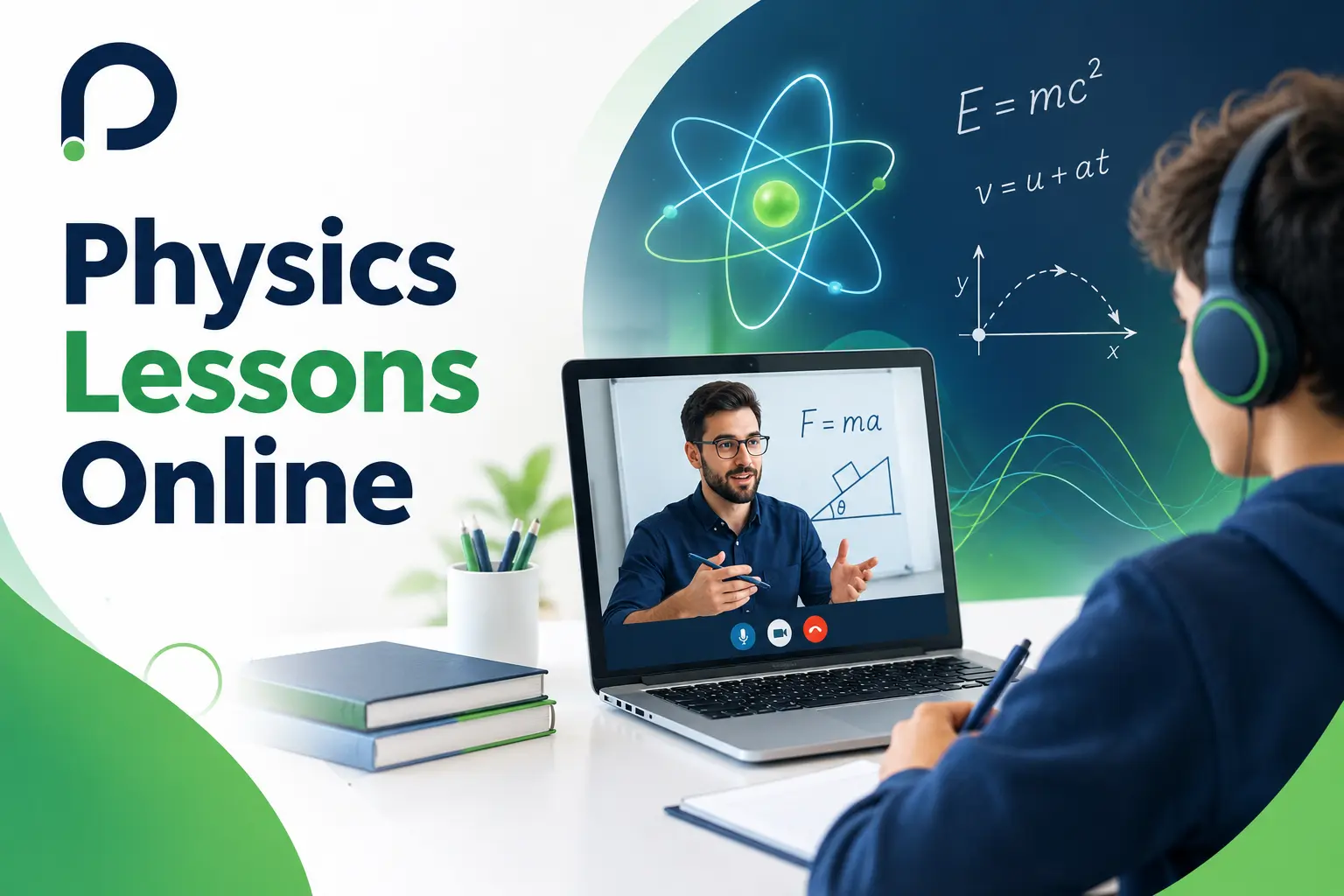
Engaging Strategies for Online Physics Lessons
Physics is the subject that suffers most from being taught badly and the subject that transforms most completely when it is taught well. The difference is rarely the teacher’s knowledge; it is whether the student is watching physics happen or watching someone recite it. Moving the lesson online adds a layer of difficulty, since you lose the apparatus, the demonstrations, and the shared physical space. At Profyd we work with physics teachers who have solved this problem, and their methods are more practical and more repeatable than you might expect. This article sets out how engaging online physics teaching actually works.
Why Physics Loses Students in the First Place
Understanding the failure mode makes the solutions obvious. Students disengage from physics for three specific reasons. The first is that they are asked to accept abstractions before they have any physical intuition to attach them to. A student who has never watched something accelerate has nothing to hang the equation on, so the equation becomes a string of symbols to memorize.
The second is that mathematics arrives too early. Physics becomes, in the student’s mind, a subject about rearranging formulas, which is both boring and a misrepresentation of what physics is. The third is the absence of “why.” Students are told what happens without ever being invited to predict, test, or be surprised. Curiosity requires a gap between expectation and outcome, and traditional teaching often closes that gap before it opens. Every technique that follows is essentially a way of addressing one of these three failures.
Build the Picture Before the Equation
The most reliable structural change a physics teacher can make is inverting the usual order. Instead of definition, then formula, then example, teach phenomenon, then reasoning, then formula. Take momentum. The conventional approach states the definition, gives the formula, and works through problems. The alternative starts with a question: why does a heavy trolley moving slowly hurt as much as a light one moving fast? The student reasons toward the idea that mass and velocity trade off against each other, and only then is given the formula, which now confirms something they already sensed rather than introducing something arbitrary.
This takes slightly longer and produces understanding that survives beyond the exam. It also works over video without any equipment, because the raw material is the student’s existing experience of the physical world. The habit to develop is asking, before any topic, what everyday experience the student already has that touches this idea. There is almost always one, and finding it is the whole job.
Demonstrating Without a Laboratory
The absence of apparatus feels like the central problem of online physics teaching and is actually the easiest to solve, because several substitutes are genuinely good. Household demonstrations are underused. A pen, a book, a glass of water, a phone torch, and a length of string cover an enormous amount of mechanics, optics, and wave behaviour. Better still, ask the student to perform the demonstration at their end. A student who drops two objects of different mass themselves remembers the result permanently; a student who watches you do it remembers a video.
Simulations cover what household objects cannot. Interactive physics simulations allow students to change a variable and watch the consequence, which is exactly the experience a laboratory provides and often more controllable. The key is not to run them as a display but to hand control to the student and ask them to predict before they change anything.
Videos of real phenomena slow motion collisions, projectile paths, and wave interference supply the things that cannot be reproduced at home. Used briefly and with a specific question attached, they anchor a concept firmly.
Your own drawing on a digital whiteboard remains the workhorse. A diagram built up gradually in front of the student, with the reasoning spoken as it is drawn, is far more effective than a completed diagram presented whole. The student watches the thinking, not just the result.
Keeping the Student Active on Screen
Attention over video decays much faster than attention in a room, because the social pressure to stay engaged is largely absent. The remedy is structural rather than motivational: build the lesson so that passivity is impossible.
Practical techniques that hold attention reliably:
Ask the student to predict an outcome before any demonstration or calculation, hand them control of the whiteboard to attempt a step themselves, deliberately make an error and ask them to find it, break any explanation longer than four minutes with a question, and end each concept by asking them to explain it back in their own words.
That last technique is the most diagnostic thing available to an online teacher. A student who can restate an idea has understood it. A student who repeats your phrasing exactly has memorized it. The difference is invisible if you never ask. Prediction deserves special mention because it is the engine of curiosity. When a student commits to an answer and turns out to be wrong, the correction lands with real force. When they are simply told the answer first, nothing lands at all.
Handling Problem-Solving Well
Physics problems are where students most often give up, and usually because they were taught to search for the right formula rather than to model the situation. A better sequence, taught explicitly and repeated until it becomes habit: describe what is physically happening, draw it, identify what is known and unknown, decide which principle governs the situation, and only then reach for equations. Students who internalize this can attempt unfamiliar problems. Students who pattern-match formulas cannot. It also helps to work problems deliberately slowly at first, thinking aloud, including the false starts. Watching a teacher move confidently to a correct answer teaches nothing about how to handle being stuck. Watching a teacher try something, notice it will not work, and choose differently teaches exactly that.
Using the Screen Rather Than Fighting It
Online teaching has advantages that a physical classroom does not, and good physics teachers exploit them. You can pause and replay any video demonstration as often as needed. You can zoom into a diagram. You can keep a running document of the student’s own notes that persists across sessions. You can share a simulation the student then keeps and explores between lessons. And because sessions are usually one-to-one, you can adapt pace continuously in a way no classroom permits. The one-to-one setting in particular changes what is possible. You can find out precisely where a student’s understanding breaks and rebuild from that exact point, which is the single most valuable thing tutoring offers and the reason families pay for it.
Conclusion
Engaging online physics leassons online is not about entertainment or elaborate technology. It comes from building physical intuition before mathematics, demonstrating with whatever is at hand, handing the student control often enough that passivity is impossible, and teaching problem-solving as modelling rather than formula selection. Teachers who work this way find that the screen stops being an obstacle and becomes a reasonably good tool.
If you teach physics and want to put these methods to work with students who need them, Profyd connects skilled physics teachers with students across a range of curricula and levels. We are currently offering physics teaching jobs in both online and onsite formats, with day and night shifts available depending on the students being served. Teachers in Lahore, Pakistan, looking for either a day or a night shift are welcome to contact the Profyd team to discuss the opportunities available to them.
Frequently Asked Questions
What equipment do I need to teach physics online?
A reliable connection, a headset, a digital whiteboard, and ideally a graphics tablet or stylus. A drawing surface matters more in physics than in most subjects because diagrams carry so much of the explanation.
How do I handle practical and laboratory requirements?
Through simulations, video of real experiments, and household demonstrations performed by the student. For examination purposes, focus on experimental design, sources of error, and data interpretation, which are what is actually assessed.
How long should an online physics lesson be?
Sixty minutes suits most secondary students. Younger students do better with forty-five. Beyond ninety minutes, attention rarely holds regardless of quality.
How do I help a student who is strong at maths but weak at physics?
Almost always by rebuilding physical intuition. Such students are usually solving equations without any model of the situation, so return to phenomena and reasoning before touching the algebra.
What if a student refuses to engage on camera?
Give them something to do rather than something to watch. Handing over the whiteboard or asking for predictions usually restores engagement faster than any appeal for attention.
Is online physics teaching as effective as classroom teaching?
For one-to-one instruction, frequently more so, because the pace adapts continuously to a single student rather than to a class average.